Joint Replacement
Total Hip Replacement in Los Angeles
Hip pain that wakes you at night, stiffness that makes socks a struggle, a limp you didn't have last year — these are signs the joint is wearing down. Dr. Joe Cooper performs total hip replacement to take that pain out of daily life and get you moving again.
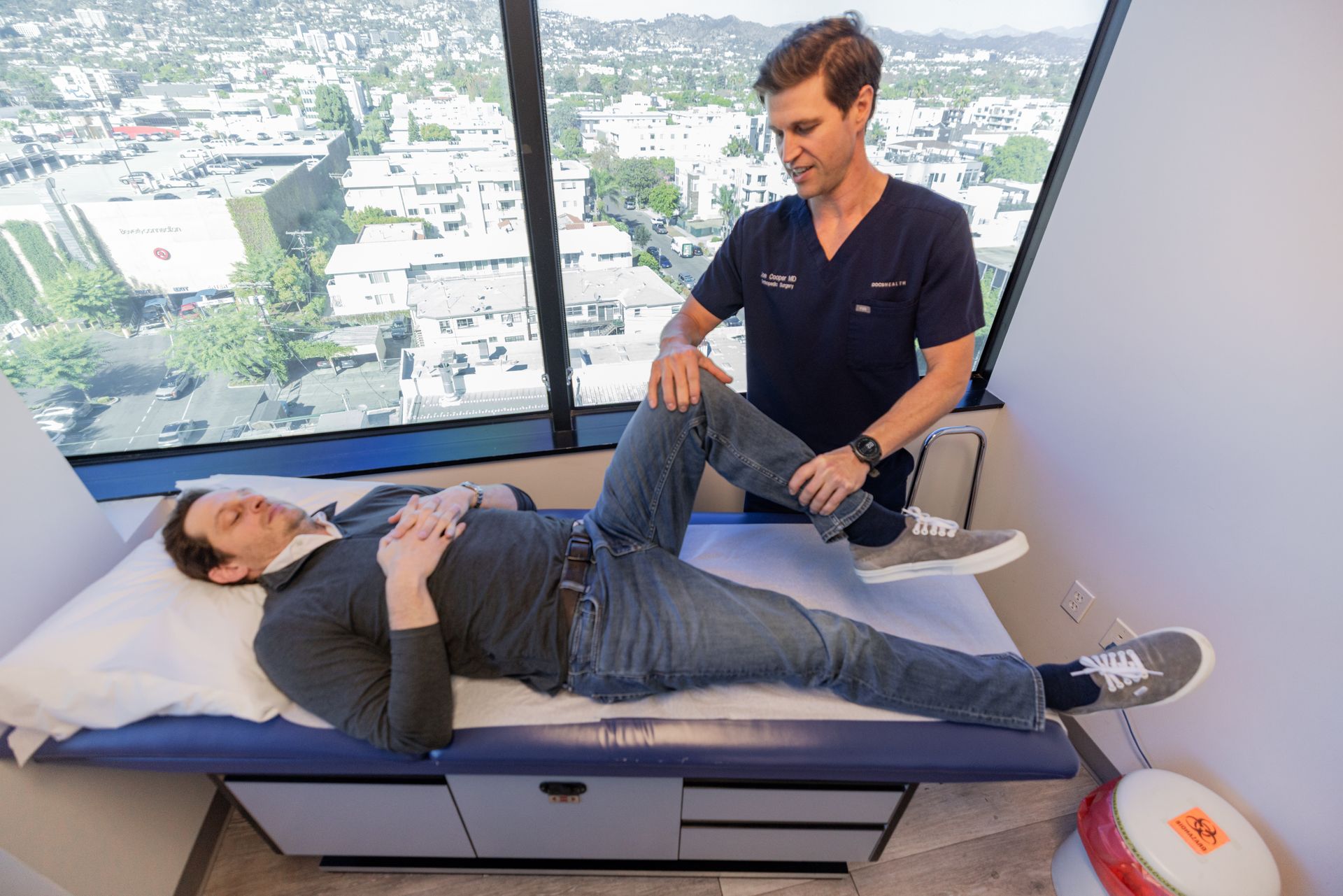
What the Procedure Is
What Happens During a
Hip Replacement
Your hip is a ball-and-socket joint. Over time, arthritis, an old injury, or loss of blood supply to the bone can wear away the smooth cartilage that lets the ball glide inside the socket. Bone rubs on bone. That's the deep groin ache most patients describe.
In a total hip replacement, Dr. Cooper removes the damaged ball at the top of the thigh bone and resurfaces the socket. Both are replaced with implant components — a metal stem and ball, and a smooth liner in the socket. The new joint moves the way the old one did before it wore out.
Many hips can be replaced through a minimally invasive approach, which uses a smaller incision and works between muscle planes rather than cutting through them. That often means less pain early on and a faster return to walking. Whether that approach suits you depends on your anatomy, your weight, and how much bone loss is present — Dr. Cooper reviews your imaging and tells you directly which method fits your hip.
Your Care Path
From First Visit to
Walking Again
Step 01
Consultation and Imaging
You meet Dr. Cooper, describe what hurts and what you can no longer do. X-rays of the hip are reviewed with you on screen so you can see the joint space yourself.
Step 02
Trying Non-Surgical Options First
Not every painful hip needs surgery right away. Activity changes, anti-inflammatories, physical therapy, or an injection may buy you comfortable time. Surgery is recommended when those stop working.
Step 03
Surgical Planning
Implant size and position are planned from your imaging before the day of surgery. You'll also complete medical clearance so any blood pressure, diabetes, or heart concerns are addressed ahead of time.
Step 04
The Surgery
The procedure itself usually takes one to two hours. Most patients have spinal anesthesia with sedation rather than general anesthesia, which tends to mean less nausea afterward.
Step 05
Getting Up and Home
You stand and take steps with a walker the same day in most cases. Many patients go home the day of surgery or the next morning, depending on how they're moving and who's at home to help.
Step 06
Recovery and Follow-Up
Physical therapy starts right away to rebuild strength and range of motion. Follow-up visits track healing, and Dr. Cooper clears you stage by stage for driving, work, and exercise.

Why Patients Choose This Practice
Surgeon-Led Care from
Start to Finish
Hip replacement is a technical operation, and the person who plans it should be the person who performs it and the person who sees you afterward. At this practice in Los Angeles, that's Dr. Joe Cooper.
You'll hear the plan in plain language: what's worn out, what the implant does, what recovery actually looks like week by week, and what the honest limits are. If your hip isn't ready for replacement, you'll be told that too.
Joint replacement sits alongside sports injury repair and regenerative treatment here, which means the conversation isn't limited to one answer. Some hips do better with time and targeted treatment. Others have reached the point where an implant is the option that restores real function.
Dr. Cooper handles your consultation, your surgery, and your follow-up visits.
Smaller incision and muscle-sparing technique used where your anatomy allows.
Clear timelines for walking, driving, working, and returning to activity.
How We Work
What Guides Every
Hip Case
Surgery When It's Earned
A hip replacement is offered when pain and loss of function justify it — not before. Conservative care gets a fair trial first.
Honest Expectations
Implants relieve arthritis pain and restore movement. They are not a new 25-year-old hip. You'll hear what's realistic for your case.
Planning Before the Incision
Implant sizing, leg length, and component position are worked out from imaging ahead of time so decisions aren't improvised in the operating room.
Common Questions
Common Questions About Hip Replacement
Most patients walk with a walker or cane the day of surgery and shift to walking unaided within two to four weeks. Desk work is often possible around three to four weeks; physical jobs take longer. Full strength and comfort usually continue improving for three to six months. Your own timeline depends on your fitness beforehand, your other health conditions, and how consistently you do your therapy.
The total depends on your insurance plan, your deductible, the facility where surgery is performed, and the anesthesia and therapy involved. Our office verifies your benefits before scheduling and gives you an estimate of your out-of-pocket portion in writing, so you are not guessing. Call (424) 800-3627 and we'll start that check for you.
Age alone doesn't decide it. What matters is how much the hip limits your life and whether the joint damage is severe enough that an implant will help. Younger patients are counseled about the possibility of a revision later in life. Older patients are assessed for medical fitness to undergo surgery safely. Dr. Cooper makes that call with you after reviewing your imaging and health history.
Many total hip replacements are now done with a same-day discharge or a single overnight stay. It depends on how your pain is controlled, how steady you are on your feet, your other medical conditions, and whether someone can help you at home for the first few days. This is decided in advance so you can plan.
Still Have Questions?
We're Here to Help
Our team is happy to answer any questions you have about treatments, appointments, and what to expect.
Contact UsNo referral required
Next Step
Find Out Whether Your Hip Needs Replacing
Bring your symptoms and any recent imaging. You'll leave the visit knowing what's wrong with the joint and what your options are — surgical and otherwise.